How to Use the Cruising & Traffic Support (CTS)
CTS operation conditions
The CTS speed can be set when all of the following conditions are met.
-
The brake pedal is not depressed.
-
The vehicle speed is about 0 km/h (0 mph) to 145 km/h (90 mph).
-
The Hill Descent Control is not operating.
-
The Smart Brake Support (SBS) is not turned off.
-
The TCS/DSC is not turned off.
Setting the CTS
-
If the CTS standby indicator light (white)
 is not turned on, press and hold
  on the steering switch.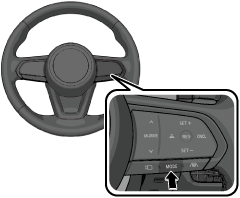
The system is switched on and the CTS standby indicator light (white)
turns on. -
If the steering assist indicator light (white)
 is not turned on, press
  on the steering switch.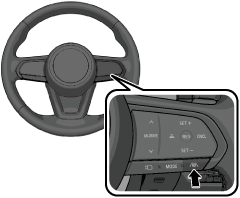
The CTS turns on and the steering assist indicator light (white)
turns on. -
Accelerate to the desired speed.
-
Press
 or
or  on the steering switch.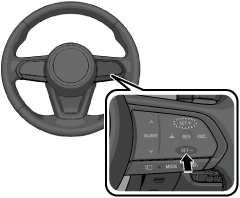
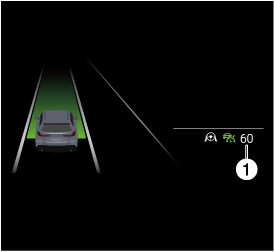
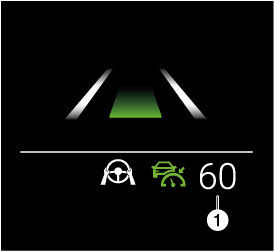
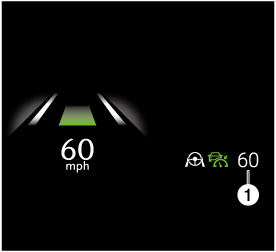
Constant speed driving starts when the vehicle speed is set. In addition, the set speed is displayed on the screen, and the CTS standby indication (white)
changes to the CTS set indication (green)  .
.
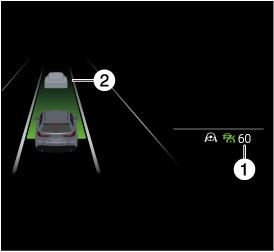
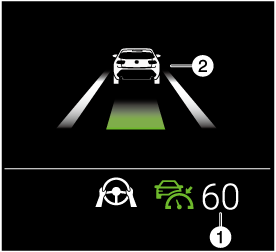
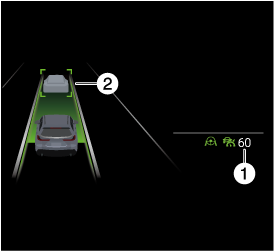
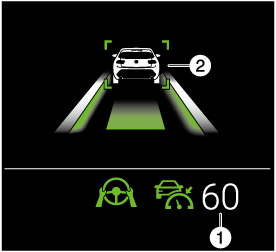
If a vehicle ahead is detected while traveling at a constant speed, the system switches to headway control. The vehicle ahead indication is displayed on the screen while in headway control.
|
Driving condition |
Instrument cluster display |
Active driving display indication |
|
|---|---|---|---|
|
i-ACTIVSENSE display |
Other than i-ACTIVSENSE display |
||
|
During travel at constant speed |
 |
 |
 |
|
During travel under headway control |
 |
 |
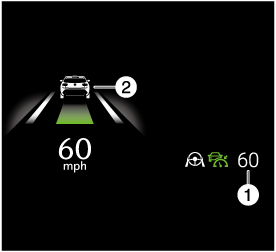 |
1 Set speed
2 Vehicle ahead indication
When the driver operates the turn signal to change to a passing lane while driving at a vehicle speed of about 80 km/h (50 mph) or faster, the system gently accelerates to assist in passing.
When the driver operates the turn signal to change lanes and get behind a vehicle moving slower than your vehicle while driving at a vehicle speed of about 80 km/h (50 mph) or faster, the system gently decelerates to assist in changing lanes.
If there is a structure on the road or an obstruction at a low height off the ground in front of the vehicle, the system may recognize it as a vehicle ahead.
Acceleration and deceleration by accelerator pedal operation takes priority while traveling at a constant speed or in headway control. When the accelerator pedal is released, the vehicle returns to driving at a constant speed or headway control at the set speed.
The forward camera may not be able to detect target objects correctly, and the CTS may not operate normally.
Refer to Forward Camera (Search).
The front radar sensor may not be able to detect target objects correctly, and the CTS may not operate normally.
Refer to Radar Sensors (Search).
If a vehicle ahead is traveling at an extremely low speed, the system may not detect it correctly.
While driving using the CTS, intended engine braking is not applied even if the shift selector is operated.
The brake lights turn on while the brakes are operated by the CTS control.
When the Driver Monitoring (DM) is turned on while the CTS is operating, the driver monitoring camera monitors the driver's head position and eye gaze.
Refer to Driver Monitoring Camera (Search).


The steering assist function operates if all of the following conditions are met while traveling at a constant speed or in headway control.
-
The vehicle is driven near the center of the lane and the white (or yellow) lane lines on both sides are detected clearly, or a vehicle ahead is clearly detected.
-
The steering wheel is not turned sharply.
-
The turn signal lever is not operated.
When the steering assist function operates, the steering assist operation display changes from white to green.
|
Driving condition |
Instrument cluster display |
Active driving display indication |
|
|---|---|---|---|
|
i-ACTIVSENSE display |
Other than i-ACTIVSENSE display |
||
|
During travel at constant speed |
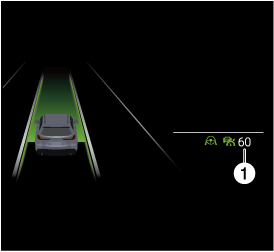 |
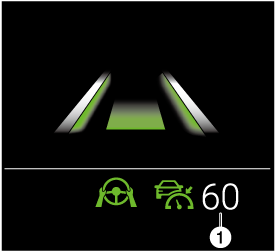 |
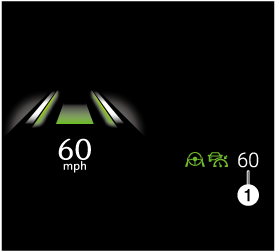 |
|
During travel under headway control |
 |
 |
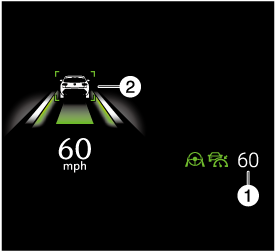 |
1 Set speed
2 Vehicle ahead indication
The steering assist function assists the steering wheel operation so that the vehicle remains near the center of the driving lane, however, the function might not be able to keep the vehicle near the center of the driving lane when any of the following conditions is met.
-
The vehicle speed is high.
-
The horizontal curvature of the road is too tight for safe navigation.
-
The vehicle is driven on a road with steep or up and down (wavy) slopes.
-
The vehicle is driven on a road with a large lateral gradient.
If the vehicle ahead stops during headway control, your vehicle in headway control also stops. While the vehicle is stopped, the CTS indicator light  in the Instrument cluster turns on.
When the vehicle ahead accelerates from a stop and one of the following operations is performed, your vehicle starts driving.
-
Press
 on the steering switch.
 -
Depress the accelerator pedal.
If the vehicle ahead resumes driving within 3 seconds after the vehicle was stopped by the system, your vehicle also resumes driving automatically.
If the driver monitoring determines that the driver is looking ahead while driving the vehicle on a highway, the vehicle automatically starts moving even if 3 seconds or longer have passed.
However, if the system cannot determine that the vehicle is driven on an expressway (such as when driving on an expressway above a general road) or if the driver monitoring camera cannot determine the driver is paying attention through head position and eye gaze (such as when the driver is wearing sunglasses or a mask), the vehicle does not start automatically.
Refer to Driver Monitoring (DM) (Search).
If the vehicle is stopped by the system continuously for 10 minutes or longer, the parking brake is applied automatically. At this time, the CTS is canceled.
If the i-stop operation conditions are met while the vehicle is stopped, the i-stop function operates without depressing the brake pedal. The engine restarts automatically when you start driving the vehicle.
Refer to i-stop (Search).
Changing the set vehicle speed
Changing the set vehicle speed using the steering switch
Operate or on the steering switch until the desired speed is reached.
-
Press and release immediately: 1 km/h (1 mph)
-
(Israel)
Press and hold/flick: 10 km/h (5 mph)
-
(Except Israel)
Press and hold: 10 km/h (5 mph)
The flick operation of the steering switch can be turned on using Mazda Connect.
Tap  displayed on the navigation bar of the center display to set, or consult an Authorized Mazda Dealer.
Changing the set vehicle speed using the accelerator pedal
Depress the accelerator pedal and press or on the steering switch at the desired speed.
Reading the set speed from the speed limit sign using the steering switch (Speed Limit Assist only)
Press  on the steering switch when the speed sign set indication is turned on.
The function which recognizes speed limit signs has limitations. Always check the speed that was read before setting the vehicle speed.
If the speedometer unit and the speed limit sign unit differ, the driver may read a speed that is not intended.
The Speed Limit Assist uses the Traffic Sign Recognition system (TSR).
Refer to Traffic Sign Recognition System (TSR) (Search).
The Speed Limit Assist cannot read speeds of less than 30 km/h (19 mph).
Set vehicle speeds read from speed limit signs can be adjusted.
Tap displayed on the navigation bar of the center display and select “Safety” → “Driver Assistance System” → “Speed Limit Sync Offset”, or consult an Authorized Mazda Dealer.
The Speed Limit Assist can be turned off.
Tap displayed on the navigation bar of the center display and select “Safety” → “Driver Assistance System” → “Traffic Sign Speed Limit Sync”, or consult an Authorized Mazda Dealer.
Setting the distance-between-vehicles during headway control
-
Press
 on the steering switch.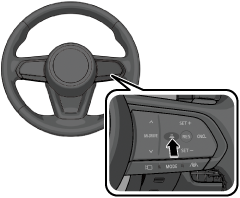
CTS is not operating (white)
|
Distance-between-vehicles guideline (at 80 km/h (50 mph) vehicle speed) |
Instrument cluster display |
Active driving display indication |
|
|---|---|---|---|
|
i-ACTIVSENSE display |
Other than i-ACTIVSENSE display |
||
|
Long (about 70 m (229 ft)) |
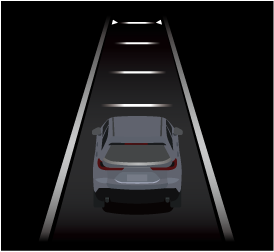 |
 |
 |
|
Medium (about 60 m (196 ft)) |
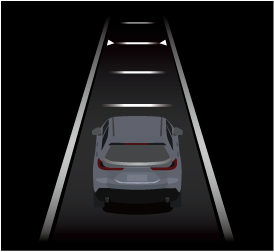 |
 |
 |
|
Short (about 45 m (147 ft)) |
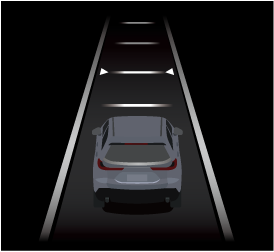 |
 |
 |
|
Extremely short (about 30 m (98 ft)) |
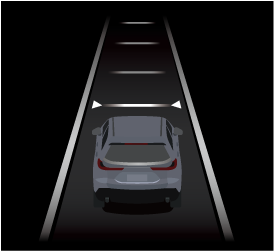 |
 |
 |
CTS is operating (green)
|
Distance-between-vehicles guideline (at 80 km/h (50 mph) vehicle speed) |
Instrument cluster display |
Active driving display indication |
|
|---|---|---|---|
|
i-ACTIVSENSE display |
Other than i-ACTIVSENSE display |
||
|
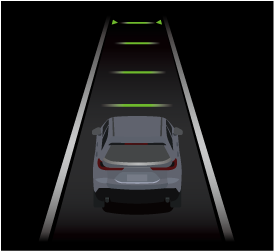
Long (about 70 m (229 ft)) |
 |
 |
 |
|
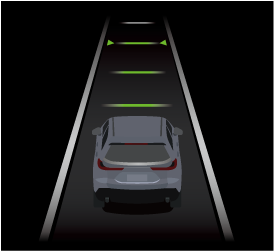
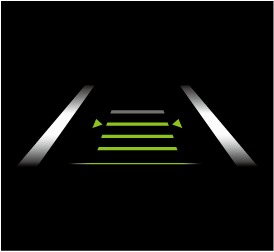
Medium (about 60 m (196 ft)) |
 |
 |
 |
|
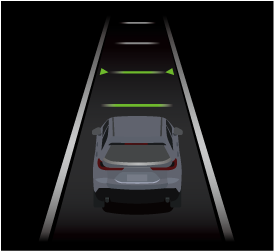
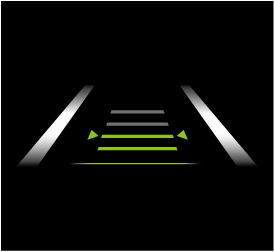
Short (about 45 m (147 ft)) |
 |
 |
 |
|
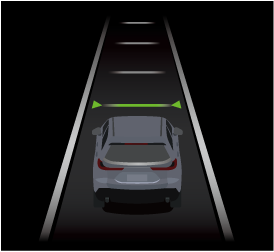
Extremely short (about 30 m (98 ft)) |
 |
 |
 |
The distance-between-vehicles can be set to 4 levels: Long, medium, short, and extremely short distance.
The distance-between-vehicles differs depending on the vehicle speed, and the slower the vehicle speed, the shorter the distance.
Conditions required for operating the Lane Change Assist
The Lane Change Assist operates when all of the following conditions are met.
-
The CTS is engaged and the steering assist function is operating.
-
The vehicle speed is about 70 km/h (44 mph) to 140 km/h (86 mph).
-
The system recognizes that the vehicle is driven on an expressway with a center median or highway.
-
The system recognizes traffic lane lines as white dashed lines.
-
There are no other vehicles in the lane change destination.
-
The vehicle is driven on roads with multiple lanes.
-
The steering wheel is not turned sharply.
Update the SD card of the map data regularly to maintain the performance of the Lane Change Assist.
The front side radar sensors may not be able to detect target objects correctly, and the CTS may not operate normally.
Refer to Radar Sensors (Search).
Using the Lane Change Assist
Do not use the Lane Change Assist under the following conditions.
-
The vehicle is driven on roads with 1 lane on one side.
-
The traffic lane lines are not white dashed lines.
-
The vehicle is driven on a road other than expressway or highway.
When the Lane Change Assist indicator light (white)  is turned on, move the turn signal lever to position 2 or 3.
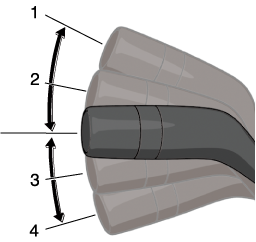
The Lane Change Assist operates and the Lane Change Assist indicator light (white)
changes to the Lane Change Assist indicator light (green)  .
.
When the lane change is completed, the turn signal lights turn off automatically and the Lane Change Assist indicator light (green) changes to the Lane Change Assist indicator light (white) .
When changing lanes without using the Lane Change Assist, operate the turn signal lever to position 1 or 4.
When the Lane Change Assist is temporarily canceled
If any of the following conditions are met, the Lane Change Assist is temporarily canceled.
-
The lane lines cannot be detected.
-
The turn signal lever is operated to the 2nd position.
-
The turn signal is operated in the opposite direction to the lane change direction.
-
The steering wheel, accelerator pedal, or brake pedal is operated.
-
Hands off steering wheel warning is activated.
-
Another vehicle is detected near your vehicle.
Turning off the Lane Change Assist
The Lane Change Assist can be turned off using Mazda Connect.
Tap displayed on the navigation bar of the center display to set, or consult an Authorized Mazda Dealer.
Warnings by CTS
Close proximity warning
The vehicle is driven in headway control
If your vehicle approaches a vehicle ahead while in headway control, a warning sound and a display cautions you.

1 “Depress Brake Pedal.”
The close proximity warning may not be activated in the following cases.
-
The vehicle is driven at the same speed as the vehicle ahead.
-
Directly after the CTS is set.
-
Immediately after the accelerator pedal is released.
-
Another vehicle cuts into the driving lane.
Do not use the CTS under conditions in which the close proximity warnings are frequently activated.
The Lane Change Assist is operating
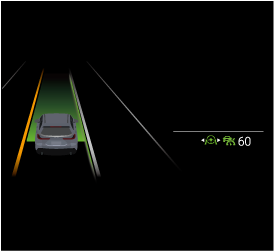
If a rapidly approaching vehicle is detected while the Lane Change Assist is operating, the screen display and warning sound alerts the driver. In addition, the system may assist the driver with the steering operation to avoid approaching vehicles.
Instrument cluster (i-ACTIVSENSE display)
Instrument cluster (Other than i-ACTIVSENSE display)
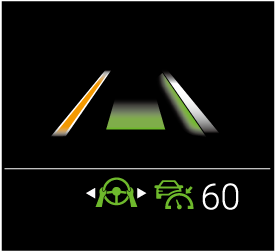
Steering assist limit warning
If the steering assist function cannot keep the vehicle within the lane lines, a screen display and a warning sound urge you to operate the steering wheel.
Instrument cluster
1 “Lane Departure Detected. Apply Steering Input”
Hands off steering wheel warning
The CTS steering assist function is operating
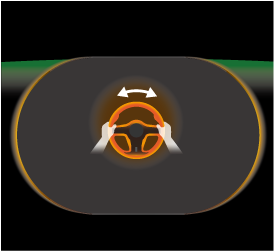
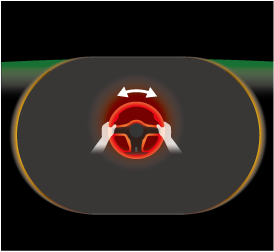
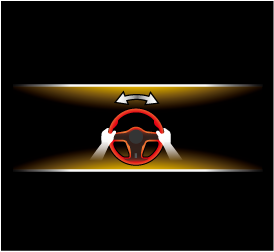
If you take your hands off the steering wheel, a warning (amber) is indicated on the instrument cluster and the active driving display. Then, if you continue to leave your hands off the steering wheel, a warning (red) is indicated on the instrument cluster and the active driving display and a warning sound is activated.
This warning is canceled by lightly operating the steering wheel to the left or right.
Instrument cluster
Warning (amber)
Warning (red)
Active driving display
Warning (amber)

Warning (red)
The Lane Change Assist is operating
If you take your hands off the steering wheel while the Lane Change Assist is operating, a warning is indicated in the instrument cluster and on the active driving display. Then, if you continue to leave your hands off the steering wheel, the Lane Change Assist is canceled.
Instrument cluster

1 “Hold Steering Wheel For Lane Change Assist”
Driver Inattention warning
If the driver does not pay attention to the road ahead, a warning (amber) is displayed in the instrument cluster.
This warning is canceled when the driver looks ahead.
Instrument cluster
1 “Roadway Inattention Detected”
If the driver monitoring is turned off, there is no driver inattention warning.
Warning to encourage appropriate driving
If one of the following warnings persist, a warning (red) is displayed in the instrument cluster and the active driving display, and a warning sound is activated. Furthermore, the constant speed/headway control function and the steering assist function are canceled and vehicle deceleration is performed.
-
Hands off steering wheel warning (the CTS steering assist function is operating)
-
Driver inattention warning
Instrument cluster
1 “Gently Apply Steering Input”
When the Unresponsive Driver Support operates
When all of the following conditions are met, the Unresponsive Driver Support operates.
-
The CTS steering assist function is operating.
-
The warning encouraging appropriate driving continues for a certain period of time.
When the Unresponsive Driver Support operates, the driver is notified that the system has been initiated with a warning sound and voice guidance, steering wheel vibration and an indication on the center display and in the instrument cluster stating that the system is on stand-by to decelerate and stop the vehicle.
The timing of the steering wheel vibrations (2 to 3 times) is as follows. An abnormality in the driver is detected.
-
An abnormality in the driver is detected.
-
The vehicle begins to decelerate and stop.
If the cancel operation is not performed within a certain period of time, the system starts decelerating the vehicle.*1
-
The vehicle is decelerated and stopped while keeping the vehicle from deviating from the lane lines as much as possible.
Instrument cluster
1 “Decelerating. Gently Apply Steering Input to Cancel”
Center display
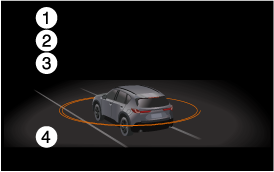
1 “CTS: Driver Inattention Detected”
2 “The vehicle is slowing.”
3 “Please wait for the vehicle to come to a complete stop.”
4 “Alerting surrounding vehicles and pedestrians for safety.”
When the Unresponsive Driver Support operates, acceleration cannot be performed by the accelerator pedal operation.
If the driver does not return to normal driving and the Unresponsive Driver Support is not canceled, the hazard warning lights flash.
Lane keeping by the steering assist function may not operate under the following conditions.
-
The white (or yellow) lane lines cannot be detected. (Poor visibility, multiple lines are drawn, lines are cut off, or confusing lines are visible)
-
The white (or yellow) lane lines on both sides of the vehicle lane are not parallel.
-
The vehicle is traveling too fast.
-
The vehicle is shaken after hitting a road bump.
-
The vehicle is making a sharp curve.
-
The steering wheel is operated abruptly.
-
The vehicle crosses a lane line.
-
The width of the vehicle lane is narrow or wide.
-
The vehicle suddenly decelerates.
Vehicle is stopped by the Unresponsive Driver Support
After the vehicle has been decelerated to a stop by the Unresponsive Driver Support, the following is performed automatically.
-
The parking brake is applied.
-
All the doors are unlocked.
-
The hazard warning lights turn on.
-
A Private eCall is placed to emergency services through a paired cellular device.
Refer to Private eCall (Search).
The details on vehicle controls by the Unresponsive Driver Support are displayed in the instrument cluster.
Pressing the hazard warning light switch stops the flashing of the hazard warning lights and cancels the Unresponsive Driver Support.
When the Unresponsive Driver Support operates, the CTS cannot be temporarily used.
Canceling the Unresponsive Driver Support during operation
Cancel the Unresponsive Driver Support following the instructions indicated in the instrument cluster or on the active driving display.
The Unresponsive Driver Support can also be canceled if any of the following conditions are met.
-
The steering wheel is lightly operated to the left or right.
-
The vehicle is driven intentionally, such as operating a pedal to accelerate/decelerate with the steering wheel properly held.
-
The hazard warning light switch is pressed while the vehicle is being driven and the hazard warning lights are flashing.
-
The power switch is switched OFF.
-
The parking brake is released.
When any of the following conditions is met, it may not be possible to detect that the steering wheel is being held.
-
The driver is wearing gloves.
-
A cover is installed to the steering wheel.
-
Holding the spoke part or the leather seams.
-
Driving with your hands lightly holding onto the steering wheel.
When any of the following conditions is met, the steering wheel may be incorrectly detected as being held.
-
Something other than your hands is in contact with the handlebars.
-
Objects or arms are brought close to the steering wheel over a wide area.
The CTS is temporarily canceled
Constant speed/Headway control function
If any of the following conditions is met, the constant speed/headway control function is temporarily canceled.
-
The brake pedal is depressed.
-
 on the steering switch is pressed.
 -
The shift selector is shifted to a position other than D.
-
The vehicle ahead disappears while driving at a speed of about 30 km/h (19 mph) or slower.
-
The TCS/DSC has operated.
-
The Smart Brake Support (SBS) has operated.
-
The front radar sensors cannot detect target objects.
-
The parking brake is applied.
-
The driver's seat belt is unfastened.
If the CTS is temporarily canceled, it operates at the previously set speed by pressing on the steering switch.
Steering assist function
If any of the following conditions is met, the steering assist function is temporarily canceled. The steering assist function is automatically restored when its operation conditions are met.
-
The constant speed/headway control function is canceled.
-
White (yellow) lane lines cannot be detected or a vehicle ahead cannot be recognized.
-
The turn signal lever is operated.
-
The steering wheel is operated abruptly.
-
Hands are off the steering wheel.
-
The vehicle is making a sharp curve.
-
The vehicle crosses a lane line.
-
The width of the vehicle lane is narrow or wide.