Radar Sensors
The radar sensor detects objects by sending radio waves in a specific direction and receiving the reflected waves back.
Vehicle front
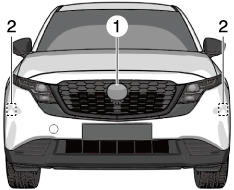
1 Front radar sensor
2 Front side radar sensors (Some Models)
Vehicle rear
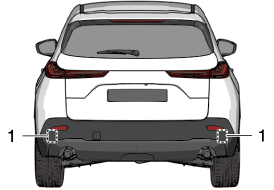
1 Rear side radar sensors
Heed the following cautions so that the radar sensors can function normally.
-
Do not modify the suspensions.
-
Use the specified tire size and the same type of tire on all 4 wheels. In addition, do not use tires with significantly different wear patterns or tire pressures on the same vehicle (including temporary spare tire).
-
Do not spray highly pressurized water against the radar sensors or rub them strongly.
-
Do not apply stickers on parts near the radar sensors.
-
If foreign matter adheres to parts near the radar sensors, remove it and switch the vehicle power OFF. The foreign matter detection status is reset by switching the vehicle power OFF.
-
Consult an Authorized Mazda Dealer if you need to repair, replace, or paint parts near the radar sensors.
-
Do not install any parts that cover the front of the radar sensors.
-
Do not replace the radiator grille and emblem with anything other than genuine products.
If strong force is applied to parts near the radar sensors, the direction of the radar sensor may become deviated and each system may not operate normally. Stop each system immediately and have the vehicle inspected by an Authorized Mazda Dealer.


The radar sensors include a function for detecting abnormalities in the sensor, soiling of the sensor's front surface, and informing the driver. If a message appears on the screen that can be addressed, follow the directions of the message.
Front radar sensor
The following systems utilize the front radar sensor.
-
High Beam Control System (HBC)
-
Lane Departure Warning System (LDWS)
-
Front Cross Traffic Alert (FCTA)
-
Mazda Radar Cruise Control (MRCC)
-
Cruising & Traffic Support (CTS)
-
Cruising & Traffic Support (CTS) Lane Change Assist
-
Cruising & Traffic Support (CTS) Unresponsive Driver Support
-
Emergency Lane Keeping (ELK) Lane-keep Assist System (LAS)
-
Emergency Lane Keeping (ELK) Road Keep Assist
-
Emergency Lane Keeping (ELK) Blind Spot Assist
-
Emergency Lane Keeping (ELK) Head-on traffic avoidance assist
-
Smart Brake Support (SBS) forward drive detection
-
Smart Brake Support (SBS) Turn-Across Traffic
-
Smart Brake Support (SBS) Front Crossing
-
Smart Brake Support (SBS) intersection accident avoidance assist function
-
Smart Brake Support (SBS) forward/rearward detection function
When driving on roads with few vehicles ahead, a message may temporarily be displayed on the screen indicating that the front radar sensor is dirty.
When the vehicle is driven on roads in which there is an elevated road on one side or in a tunnel, the front radar sensor function may be restricted temporarily.
If the lead-acid battery power is weak, the front radar sensor detection function may decrease and each system may not operate normally.
When any of the following conditions is met, the front radar sensor may not be able to detect vehicles ahead or obstructions correctly.
-
During inclement weather.
-
Front visibility is reduced.
-
The vehicle is driven near facilities or objects emitting strong radio waves.
-
The rear surface of a vehicle ahead does not reflect radio waves effectively.
-
A vehicle ahead has limited areas that can reflect radio waves.
-
Your vehicle is tilted.
-
Foreign matter is adhering to parts near the front radar sensor.
-
The target object is near fences, guardrails, manholes, metal plates on the road, or another vehicle.
-
There are structures above the target object.
The front radar sensor may not detect the following target objects.
-
Plastic objects such as pylons
-
Glass items such as store entrances
-
Low height objects such as curbs
-
People or objects lying down
-
Pedestrians, bicycles, motorcycles, standing trees, animals, or walls
When any of the following conditions is met, the front radar sensor may detect vehicles in the adjacent lane or surrounding obstructions, or it may not be able to detect vehicles ahead or obstructions.
-
The vehicle is entering or exiting a curve.
-
The vehicle is driven on a continuously curving road.
-
The vehicle is driven on roads with repeated up and downslopes.
-
The vehicle is driven on roads with narrow lanes.
-
The vehicle is driven on poor roads or unpaved roads.
-
The vehicle ahead enters the front radar sensor's blind spot.
-
The distance to the vehicle ahead is extremely close.
-
The vehicle ahead is being driven in an unstable condition.
-
A vehicle suddenly comes close such as by cutting into your lane.
-
The vehicle is driven near facilities or objects emitting strong radio waves.
-
The distance between your vehicle and the target object is extremely close.
-
Your vehicle approaches roadside structures (such as guardrails, utility poles, standing trees, or walls).
-
Your vehicle is passing a vehicle ahead which is waiting to turn right or left.
-
The vehicle stops or is changing lanes before the object which activates the system enters the path of your vehicle.
-
The vehicle is driven on roads with structures (such as road signs or other signs) above the road.
-
The steering wheel is operated so that the vehicle approaches the path of an oncoming vehicle.
-
There are objects which move above or below the road.
-
The vehicle approaches the target object while turning.
-
The radar sensor's detection range is blocked by an adjacent wall or vehicle.
-
The vehicle ahead makes a sudden movement (such as abrupt steering, sudden acceleration, sudden deceleration).
-
Your vehicle is suddenly approaching the vehicle ahead closely.
Front side radar sensors
The following system utilizes front side radar sensors.
-
Blind Spot Monitoring (BSM) Turn Warning
-
Front Cross Traffic Alert (FCTA)
-
Cruising & Traffic Support (CTS) Lane Change Assist
-
Smart Brake Support (SBS) Front Crossing
If the vehicle is driven on roads in which there are continuous tall concrete walls or in a tunnel, the front side radar sensor function may be restricted temporarily and a message indicating a dirty front side radar sensor may be displayed.
When any of the following conditions is met, the front side radar sensors may not be able to detect target objects.
-
During inclement weather.
-
The vehicle is driven on a sharp curve or on bumpy roads.
-
Radar sensor from an adjacent vehicle causes radio wave interference.
-
The detection range of a front side radar sensor is obstructed by an adjacent wall or vehicle, or the radar is reflected.
-
A vehicle suddenly enters the detection range from the front, rear, or side of your vehicle.
-
The target object is extremely small.
-
The target object is extremely low/high.
-
A vehicle approaches while turning.
-
A vehicle that has stopped suddenly starts to move.
-
Multiple objects move at the same time.
-
The bumper around a front side radar sensor is deformed.
-
Foreign matter is adhering to the bumper around a front side radar sensor.
-
The temperature near a front side radar sensor is extremely hot.
-
The vehicle is driven near facilities or objects emitting strong radio waves.
-
The target object is near fences, guardrails, manholes, metal plates on the road, or another vehicle.
-
There are structures above the target object.
The front side radar sensors may not detect the following target objects.
-
Animals.
-
Pedestrians.
-
Bicycles and small motorcycles moving at a low speed.
-
Shopping carts.
-
Stationary objects on the road or roadside.
-
Vehicles with shapes that may not reflect radar waves.
When any of the following conditions is met, the front side radar sensors may detect vehicles in the adjacent lane or surrounding obstructions, or it may not be able to detect vehicles ahead or obstructions.
-
The vehicle is driven near facilities or objects emitting strong radio waves.
-
The distance between your vehicle and the target object is extremely close.
-
Your vehicle approaches roadside structures (such as guardrails, utility poles, standing trees, or walls).
-
Your vehicle is passing a vehicle ahead which is waiting to turn right or left.
-
The vehicle stops or is changing lanes before the object which activates the system enters the path of your vehicle.
-
The vehicle is driven on roads with structures (such as road signs or other signs) above the road.
-
The steering wheel is operated so that the vehicle approaches the path of an oncoming vehicle.
-
There are objects which move above or below the road.
-
The vehicle approaches the target object while turning.
-
The radar sensor's detection range is blocked by an adjacent wall or vehicle.
Rear side radar sensors
The following systems utilize rear side radar sensors.
-
Blind Spot Monitoring (BSM)
-
Blind Spot Monitoring (BSM) Vehicle Exit Warning
-
Blind Spot Monitoring (BSM) Turn Warning
-
Rear Cross Traffic Alert (RCTA)
-
Cruising & Traffic Support (CTS) Lane Change Assist
-
Emergency Lane Keeping (ELK) Blind Spot Assist
-
Smart Brake Support (SBS) Rear Crossing
If the vehicle is driven on roads in which there are continuous tall concrete walls or in a tunnel, the front side radar sensor function may be restricted temporarily and a message indicating a dirty rear side radar sensor may be displayed.
When any of the following conditions is met, the rear side radar sensors may not be able to detect target objects.
-
During inclement weather.
-
The vehicle is driven on a sharp curve or on bumpy roads.
-
Radar sensor from an adjacent vehicle causes radio wave interference.
-
The detection range of a rear side radar sensor is obstructed by an adjacent wall or vehicle, or the radar is reflected.
-
A vehicle suddenly enters the detection range from the front, rear, or side of your vehicle.
-
The target object is extremely small.
-
The target object is extremely low/high.
-
A vehicle approaches while turning.
-
A vehicle that has stopped suddenly starts to move.
-
Multiple objects move at the same time.
-
The bumper around a rear side radar sensor is deformed.
-
Foreign matter is adhering to the bumper around a rear side radar sensor.
-
The temperature near a rear side radar sensor is extremely hot.
-
When towing a trailer.
-
The vehicle is driven near facilities or objects emitting strong radio waves.
-
The target object is near fences, guardrails, manholes, metal plates on the road, or another vehicle.
-
There are structures above the target object.
-
Accessories such as a bicycle carrier are attached.
The rear side radar sensors may not detect the following target objects.
-
Animals.
-
Pedestrians.
-
Bicycles and small motorcycles moving at a low speed.
-
Shopping carts.
-
Stationary objects on the road or roadside.
-
Vehicles with shapes that may not reflect radar waves.
-
A vehicle is traveling alongside your vehicle at nearly the same speed for an extended period of time.
When any of the following conditions is met, the Rear side radar sensors may detect vehicles in the adjacent lane or surrounding obstructions, or it may not be able to detect vehicles ahead or obstructions.
-
The vehicle is driven near facilities or objects emitting strong radio waves.
-
The distance between your vehicle and the target object is extremely close.
-
Your vehicle approaches roadside structures (such as guardrails, utility poles, standing trees, or walls).
-
Your vehicle is passing a vehicle ahead which is waiting to turn right or left.
-
The vehicle stops or is changing lanes before the object which activates the system enters the path of your vehicle.
-
The vehicle is driven on roads with structures (such as road signs or other signs) above the road.
-
The steering wheel is operated so that the vehicle approaches the path of an oncoming vehicle.
-
There are objects which move above or below the road.
-
The vehicle approaches the target object while turning.
-
The radar sensor's detection range is blocked by an adjacent wall or vehicle.