Forward Camera
The forward camera shoots images from the front of the vehicle. i-ACTIVSENSE recognizes obstructions and division lines at the front of the vehicle from images taken from the forward camera and determines the traffic conditions.
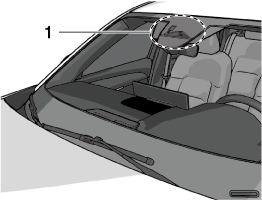
1 Forward camera
The following systems utilize the forward camera.
-
High Beam Control System (HBC)
-
Lane Departure Warning System (LDWS)
-
Traffic Sign Recognition System (TSR)
-
Driver Attention Alert (DAA)
-
Mazda Radar Cruise Control (MRCC)
-
Cruising & Traffic Support (CTS)
-
Emergency Lane Keeping (ELK)
-
Smart Brake Support (SBS) forward drive detection
-
Smart Brake Support (SBS) forward/rearward detection function
Do not modify the suspension.
If the vehicle height or inclination is changed, the system will not be able to correctly detect vehicles ahead. This will result in the system not operating normally or mistakenly operating, which could cause a serious accident.


Heed the following cautions to operate the system correctly.
-
Do not hit or apply strong force to the forward camera or the area around it. If the forward camera received a strong impact, stop using the following systems and consult an Authorized Mazda Dealer.
-
High Beam Control System (HBC)
-
Lane Departure Warning System (LDWS)
-
Traffic Sign Recognition System (TSR)
-
Driver Attention Alert (DAA)
-
Mazda Radar Cruise Control (MRCC)
-
Cruising & Traffic Support (CTS)
-
Emergency Lane Keeping (ELK)
-
Smart Brake Support (SBS) forward drive detection
-
Smart Brake Support (SBS) forward/rearward detection function
-
-
Do not remove the forward camera cover.
-
Be careful not to scratch the forward camera lens or allow it to get dirty. Also, do not take the camera apart. Otherwise, it may cause a malfunction or mis-operation.
-
The direction of the forward camera has been finely adjusted, therefore do not change the installation position or remove the forward camera. Otherwise, it may cause a malfunction or mis-operation.
-
Consult an Authorized Mazda Dealer regarding cleaning of the camera lens.
-
Do not place objects on the dashboard which reflect light.
-
Do not apply accessories, stickers, or film to the windshield near the forward camera. If the area in front of the forward camera lens is obstructed, it will cause the system to not operate correctly even if it is transparent.
-
Always keep the windshield glass around the forward camera clean by removing dirt or fogging. If the windshield is fogged, press the windshield defroster switch.
-
If the windshield near the forward camera is dirty, the system detects the dirt and informs the driver. However, it may not detect plastic shopping bags, ice, or snow depending on the conditions. In such cases, the system cannot accurately determine a vehicle or obstruction in front and may not be able to operate normally. Always drive carefully and pay attention to the road ahead.
-
When cleaning the windshield, do not allow glass cleaners or similar cleaning fluids to get on the forward camera lens. In addition, do not touch the forward camera lens.
-
Consult an Authorized Mazda Dealer regarding cleaning the interior side of the windshield around the forward camera.
-
If there are cracks or damage caused by flying gravel or debris on the windshield, always have the windshield replaced. Consult an Authorized Mazda Dealer before replacing the windshield.
-
Consult an Authorized Mazda Dealer before doing repairs around the forward camera.
-
When doing repairs around the rearview mirror, consult an Authorized Mazda Dealer.
-
Use the specified tire size and the same type of tire on all 4 wheels. In addition, do not use tires with significantly different wear patterns or tire pressures on the same vehicle (including temporary spare tire).
When all of the following conditions are met, the system detects pedestrians.
-
The height of a pedestrian is about 1 m (3.3 ft) to 2 m (6.6 ft).
-
The outline of a pedestrian is recognized such as the head, both shoulders, or the feet.
When any of the following conditions is met, the system may not be able to detect pedestrians.
-
There are multiple pedestrians.
-
A pedestrian is close to a separate object.
-
A pedestrian is crouching, lying, or slouching.
-
A pedestrian suddenly jumps into the road.
-
A pedestrian is holding something (such as an open umbrella or large baggage).
-
A pedestrian blends into the background (such as in a dark location at night or by wearing clothes matching the background color).
When any of the following conditions is met, the system may not be able to detect target objects correctly, and each system may not operate normally.
-
The headlights of your vehicle are not turned on during the night or in a tunnel.
-
The target object is in the blind spot of the forward camera.
-
A person or object bursts onto the road from the shoulder or cuts right in front of you.
-
The distance between your vehicle and the target object is extremely close or extremely far.
-
You change the course and approach a target object.
-
The target object is extremely small or a falling object.
-
A vehicle ahead is approaching from a distant driving lane.
-
The target object (vehicle ahead, white line (yellow line), sign) is dirty, worn, faded, tilted, or bent.
-
A vehicle ahead has a special shape (such as a vehicle carrier).
-
A vehicle ahead is a truck with a low loading platform.
-
A vehicle ahead has an extremely low or high profile.
-
A vehicle ahead is outside the illumination range of the headlights.
-
The brightness of the headlights of a vehicle ahead is insufficient (such as the illumination is weakened due to a dirty lens or the optical axis is deviated).
-
The illumination area of the taillights of the vehicle ahead is small.
-
The taillights of a vehicle ahead are dim or turned off.
-
The headlights of an on-coming vehicle are dim or turned off.
-
Under bad weather conditions (rain, fog, and snow).
-
Front visibility is reduced (due to a vehicle ahead casting off water, snow, or sand).
-
Strong light is directed at the front of your vehicle (such as backlight and high-beam headlights).
-
The surrounding area is dark (such as during the night, early evening, or early morning, or in a tunnel or indoor parking lot).
-
There are light sources in the surrounding area (such as street lamps, illuminated signboards, and traffic signals).
-
There are objects which reflect light (such as reflective plates and signs) in the surrounding area.
-
The surrounding brightness suddenly changes (such as when entering or exiting a tunnel).
-
The brightness of the headlights of your vehicle is insufficient (such as the illumination is weakened due to a dirty lens or the optical axis is deviated).
-
Tires other than the specified size are used on your vehicle (such as when tire chains or temporary spare tires are used).
-
The tires on your vehicle have significantly different wear.
-
Foreign matter is stuck to the windshield (such as ice, fog, snow, frost, raindrops, dirt, or a piece of plastic).
-
The windshield is dirty or fogged.
-
The forward camera is blocked by an obstruction, causing poor forward visibility (such as when roof rails are installed to the vehicle and a long object is loaded).
-
The forward camera is extremely hot or extremely cold.
-
The windshield washer is being used.
-
The windshield wipers are not used when it is raining.
-
Your vehicle is tilted (such as when heavy luggage is in the luggage compartment or on the rear seat).
-
The vehicle is making a sharp curve, or ascending or descending a steep slope.
-
The vehicle is entering or exiting a curve.
-
The vehicle is driven on a road with sharp curves or up and down (wavy) slopes.
-
The vehicle is driven on uneven roads.
-
The vehicle is driven on poor roads or unpaved roads.
-
A vehicle ahead appears and disappears due to a center median or roadside trees.
-
The vehicle is driven next to walls with no patterning (including fences and longitudinally striped walls).
-
There is a strong light reflection (such as road surface, puddles, glass, your vehicle’s headlights).
-
White (yellow) lines cannot be detected normally (due to multiple lines, broken lines, remaining lines from road repairs, shadows, remaining snow, rain tracks, partially wet road surface).
-
Areas off the road cannot be detected normally (due to low curbs, lack of contrast between lane you are driving in and area off the road, obscured by vehicle ahead, remaining road repair marks, shadows, remaining snow, rain tracks, partially wet road surface).
-
The contrast of the electronic sign is low.
-
The sign is completely or partially hidden by trees or utility poles.
-
The time to detect the sign is short.
-
A sticker which looks like a sign is attached to the rear of a vehicle ahead.
-
A mark similar to a sign is detected.
-
A sign on side roads is detected.