Driver Monitoring Camera (Some Models)
The driver monitoring camera detects changes in the driver's facial features and estimates the driver's condition.
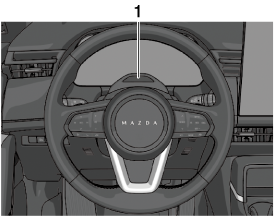
1 Driver monitoring camera
The following systems use the driver monitoring camera.
-
Lane Departure Warning System (LDWS)
-
Driver Monitoring (DM)
-
Mazda Radar Cruise Control (MRCC)
-
Cruising & Traffic Support (CTS)
-
Cruising & Traffic Support (CTS) Lane Change Assist
-
Emergency Lane Keeping (ELK)
-
Smart Brake Support (SBS) forward detection function
-
Driver Personalization System
Each system may not operate normally if any of the following conditions is met.
-
You are wearing glasses or sunglasses (objects that do not allow infrared rays to pass through).
-
Strong light (such as direct light from the setting sun or headlights) is shining on your glasses or sunglasses.
-
Strong light (such as direct light from the setting sun or headlights) is shining on the driver monitoring camera or the driver's face.
-
The driver's face is significantly out of the detection range of the driver monitoring camera, such as when the driver leans forward or is in a driving position where the driver cannot see the entire instrument cluster.
-
A cap or hat you are wearing partially blocks the driver monitoring camera's view of your eyes, you have long bangs partially covering your eyes, or a part of your face is invisible due to a scarf, face mask, beard, or hand.
-
The lighting conditions change significantly (such as backlight, light from the side, direct light from the setting sun, or the headlights of on-coming vehicles).
-
Device that emits near-infrared light is used in the cabin.
-
The temperature in the cabin is high.
-
The driver monitoring camera is blocked by the steering wheel, hands, or arms (such as when operating the steering wheel when there is a curve or when turning).
-
There is more than one face in the detection range of the driver monitoring camera, such as when the front passenger or a rear seat passenger leans forward.
The camera does not take photographic images and operates on numeric information only.