How to Use the Smart Brake Support (SBS)
During the SBS brake control, the brake pedal may move rearward or become stiff. The brakes are operating, but continue to depress the brake pedal.


When the forward detection function operates
The forward detection function operates when all of the following conditions are met and the system determines that there is the possibility of your vehicle colliding with a target object at the front.
-
(If the target is a vehicle ahead/motorcycle/bicycle)
The vehicle speed is about 4 km/h (3 mph) or faster.
-
(If an object is a pedestrian)
The vehicle speed is about 4 km/h to 80 km/h (3 mph to 49 mph).
-
The DSC does not operate.
When the forward detection function operates, the driver is notified of the danger by the screen display and warning sound. In addition, the indicator light  in the instrument cluster turns on. Furthermore, if the possibility of a collision increases, brake control is performed.
Instrument cluster

1 “BRAKE!”
Active driving display
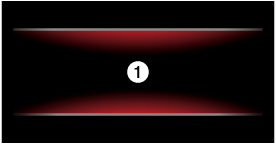
1 “BRAKE!”
If the system determines that the driver has mistakenly depressed the accelerator pedal, a screen display and a warning sound notify the driver of the danger. (Some Models) In addition, the indicator light in the instrument cluster turns on.
Instrument cluster
1 “Accelerator Depressed”
Active driving display
1 “Accelerator Depressed”
If any of the following conditions is met, the forward detection function may not operate normally.
-
The forward camera cannot detect target objects.
Refer to Forward Camera (Search).
-
The front radar sensor cannot detect target objects.
Refer to Radar Sensors (Search).
-
When there is the possibility of a partial contact with a target object.
-
The driver deliberately performs driving operations (accelerator pedal operation, steering wheel operation, shift selector operation, and turn signal lever operation).
-
The vehicle ahead suddenly decelerates or makes a sharp turn.
If the system determines that the driver has mistakenly depressed the accelerator pedal while the forward detection function is operating, the forward detection function continues to operate.
If any of the following conditions is met, the forward detection function may operate.
-
An animal or object on the road is detected.
-
Passing an approaching vehicle while rounding a curve.
-
Vehicle is passing through a narrow gate or a gate with a low ceiling.
-
There is a metal object, bump, or a protruding object on the road.
-
There is an object which activates the system on the roadside at the beginning of a curve.
(Vehicles with Driver Monitoring (DM))
If the system determines that the driver is not paying attention to the road, it activates the collision warning earlier than normal.
If the forward detection function performs brake control and the vehicle is stopped, the system will continue to hold the brakes for a brief time unless there is an operation performed by the driver.
The volume of the collision warning can be changed.
Tap  displayed on the navigation bar of the center display to set, or consult an Authorized Mazda Dealer.
The Turn-Across Traffic operation conditions (Some Models)
The Turn-Across Traffic operates when all of the following conditions are met and the system determines that there is the possibility of your vehicle colliding with a vehicle approaching in the opposite direction.
-
The vehicle speed is about 4 km/h to 40 km/h (3 mph to 25 mph).
-
The turn signal lights are flashing.
When the Turn-Across Traffic operates, the driver is notified of the danger by the screen display and warning sound. In addition, the indicator light in the instrument cluster turns on. Furthermore, if the possibility of a collision increases, brake control is performed.
Instrument cluster
1 “BRAKE!”
Active driving display
1 “BRAKE!”
If any of the following conditions is met, the Turn-Across Traffic may not operate normally.
-
The forward camera cannot detect target objects.
Refer to Forward Camera (Search).
-
The front radar sensor cannot detect target objects.
Refer to Radar Sensors (Search).
-
All of or only a part of a vehicle approaching in the opposite direction is hidden and it cannot be recognized.
-
The speed of the on-coming vehicle is too slow or too fast.
-
Turning at a large intersection with two lanes or more on one side.
-
The accelerator pedal or brake pedal is being operated.
-
The steering wheel is being operated in the straight-ahead position.
-
The vehicle resumes driving after a stop.
If any of the following conditions is met, the Turn-Across Traffic may operate.
-
The steering wheel is turned towards the on-coming traffic lane with a vehicle approaching in the opposite direction.
-
Turning right after or right before an oncoming vehicle passes.
-
The direction of movement of a vehicle approaching in the opposite direction cannot be predicted due to sudden right/left turning or sudden deceleration.
The brakes are released by the brake control of the Turn-Across Traffic as soon as the danger of a collision passes.
When Front Crossing is Operating (Some Models)
Front Crossing operates when all of the following conditions are met and the system determines that there is a possibility of your vehicle colliding with a vehicle approaching from a front side.
-
The vehicle is traveling straight at a speed of about 4 km/h to 80 km/h (2 mph to 50 mph).
-
The DSC/TCS is not operating.
-
When an approaching vehicle is traveling straight in a direction perpendicular to your vehicle.
-
The approaching vehicle is traveling at a constant speed within the range of about 4 km/h to 80 km/h (2 mph to 50 mph).
If the Front Crossing operates, a screen display and warning sound the driver notify the driver of the danger. In addition, the indicator light in the instrument cluster turns on. Furthermore, if the possibility of a collision increases, brake control is performed.
Instrument cluster
1 “BRAKE!”
Active driving display
1 “BRAKE!”
Front Crossing may not operate normally if any of the following conditions is met.
-
The forward camera cannot detect target objects.
Refer to Forward Camera (Search).
-
The front radar sensor and front side radar sensors cannot detect target objects.
Refer to Radar Sensors (Search).
-
The accelerator pedal or brake pedal is being operated.
-
The steering wheel is being operated.
-
The turn signal lever is being operated.
When the intersection accident avoidance assist function operates (Some Models)
The intersection accident avoidance assist function operates when all of the following conditions are met and the system determines that there is the possibility of your vehicle colliding with a target object at the front.
-
The vehicle speed is about 4 km/h to 30 km/h (3 mph to 19 mph).
-
The DSC is not operating.
If the intersection accident avoidance assist function operates, a screen display and warning sound notify the driver of the danger. In addition, the indicator light in the instrument cluster turns on. Furthermore, if the possibility of a collision increases, brake control is performed.
Instrument cluster
1 “BRAKE!”
Active driving display
1 “BRAKE!”
If any of the following conditions is met, the intersection accident avoidance assist function may not operate normally.
-
The forward camera cannot detect target objects.
Refer to Forward Camera (Search).
-
The front radar sensor cannot detect target objects.
Refer to Radar Sensors (Search).
If the intersection accident avoidance assist function performs brake control and the vehicle is stopped, the system will continue to hold the brakes for a brief time unless there is an operation performed by the driver.
When the head-on collision mitigation operates (Some Models)
The head-on collision mitigation operates when all of the following conditions are met.
-
The vehicle speed is about 30 km/h (19 mph) or faster.
-
The DSC is not operating
-
The vehicle approaching in the opposite direction is driving in the same vehicle lane as your vehicle.
-
The system detects the vehicle lane boundaries on both sides.
-
There is no space in the vehicle lane for the vehicle approaching in the opposite direction to take evasive action.
When head-on collision mitigation is operating, the driver is notified of the danger by the screen display and the warning sound. In addition, the indicator light in the instrument cluster turns on. Furthermore, if the possibility of a collision increases, brake control is performed.
Instrument cluster
1 “BRAKE!”
Active driving display
1 “BRAKE!”
Head-on collision mitigation may not operate normally when any of the following conditions is met.
-
The front radar sensor cannot detect target objects.
Refer to Radar Sensors (Search).
-
The vehicle in the opposite direction is stopped.
-
The speed of the vehicle approaching in the opposite direction is too slow or too fast.
-
There is the possibility of partial contact with the target object.
-
The driver deliberately performs driving operations (accelerator pedal operation, steering wheel operation, shift selector operation, and turn signal lever operation).
-
The vehicle lane makes a curve.
-
The width of the vehicle lane is extremely wide.
Even if there is no eventual collision, head-on collision mitigation may operate if the vehicle approaching in the opposite direction comes very close to the front of your vehicle.
After head-on collision mitigation operates, the brakes may be released before the collision depending on the conditions.
When the forward/rearward detection function operates
The forward/rearward detection function operates when the vehicle speed is about 15 km/h (9 mph) or slower and the system determines that there is the possibility of your vehicle colliding with an object at the front (obstruction) or rear (obstruction, pedestrian).
In addition, if the system determines that there is the possibility of your vehicle colliding with a pedestrian or vehicle ahead due to accidentally depressing the accelerator pedal, the forward/rearward detection function operates. (Some Models)
When the forward/rearward detection function is operating, the driver is notified of the danger by the screen display and the warning sound. In addition, the indicator light in the instrument cluster turns on. Furthermore, if the possibility of a collision increases, brake control is performed. In addition, if the system determines that the driver has mistakenly depressed the accelerator pedal, sudden acceleration is suppressed.
Instrument cluster
1 “BRAKE!”
Active driving display
1 “BRAKE!”
If the system determines that the driver has mistakenly depressed the accelerator pedal, a screen display and a warning sound notify the driver of the danger. In addition, the indicator light in the instrument cluster turns on.
Instrument cluster
1 “Accelerator Depressed”
Active driving display
1 “Accelerator Depressed”
If any of the following conditions is met, the forward/rearward detection function may not operate normally.
-
The forward camera cannot detect target objects.
Refer to Forward Camera (Search).
-
The front ultrasonic sensors and rear ultrasonic sensors cannot detect target objects.
Refer to Ultrasonic Sensors (Search).
-
The rear camera cannot detect target objects.
Refer to Surround Cameras (Search).
-
The front radar sensor cannot detect target objects.
Refer to Radar Sensors (Search).
When any of the following conditions is met, the forward/rearward detection function may operate.
-
There is a hanging curtain.
-
Vehicle is passing through a narrow gate or a gate with a low ceiling.
-
There is a metal object, bump, or a protruding object on the road.
If the forward/rearward detection function performs brake control and the vehicle is stopped, the brakes are automatically released after about 2 seconds when the driver does not depress the brake pedal.
If the Mazda Intelligent Drive Select (Mi-Drive) is in OFF-ROAD mode, the forward/rearward detection function is automatically turned off.
When the Rear Crossing is operating
The Rear Crossing detection function operates when the vehicle speed is about 15 km/h (9 mph) or slower and the system determines that there is the possibility of your vehicle colliding with a vehicle approaching from a rear side.
When the Rear Crossing operates, the screen display and warning sound notify the driver of the danger. In addition, the indicator light in the instrument cluster turns on. Furthermore, if the possibility of a collision increases, brake control is performed.
Instrument cluster
1 “BRAKE!”
Active driving display
1 “BRAKE!”
If any of the following conditions is met, the Rear Crossing may not operate normally.
-
The rear side radar sensors cannot detect an object.
Refer to Radar Sensors (Search).
-
A vehicle is approaching directly from the rear of your vehicle.
-
A vehicle is approaching at an angle from the rear of your vehicle.
-
A vehicle is approaching from a direction at an acute angle.
If any of the following conditions is met, the Rear Crossing may operate.
-
There is a hanging curtain.
-
Vehicle is passing through a narrow gate or a gate with a low ceiling.
If the Rear Crossing detection function performs brake control and the vehicle is stopped, the brakes are automatically released after about 2 seconds when the driver does not depress the brake pedal.
If the Mazda Intelligent Drive Select (Mi-Drive) is in OFF-ROAD mode, the Rear Crossing detection function is automatically turned off.
Turning off the SBS
There are 2 ways to turn off the SBS.
-
Tap
 displayed on the navigation bar of the center display and tap
  →
→  . indicator light turns off.
 -
Tap
displayed on the navigation bar of the center display to set, or consult an Authorized Mazda Dealer.
When the SBS is turned off, the SBS OFF indicator  turns on.
If the SBS OFF indicator light turns on with the SBS not turned off, the SBS may not operate normally. Have your vehicle inspected by an Authorized Mazda Dealer.