How to Use the Hybrid System
EV Mode
Always confirm the safety around the vehicle before using EV mode.
Because there is no engine sound, pedestrians in the surrounding area may not notice the vehicle departing or approaching.


In EV mode, the vehicle is driven by the motor only using the electrical power stored in the high voltage battery.
-
Start the hybrid system.
-
Press the EV switch.
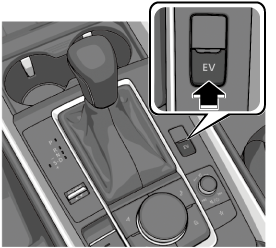
EV mode operates and the EV mode indication
 turns on.
Press the EV switch again to cancel EV mode.
-
In the following cases, switching to EV mode may not be possible. When switching to EV mode is not possible, a warning sound is activated and a message is displayed on the multi-information display.
-
The hybrid system temperature is high or low.
-
The engine is warming up.
-
The high voltage battery power is low.
-
The vehicle is driven at a high speed.
-
The accelerator pedal is fully depressed.
-
The vehicle is driven on a slope.
-
The windshield defroster switch is on.
-
-
In the following cases, EV mode is automatically canceled. When EV mode is canceled, a warning sound is activated, the EV mode indicator in the instrument cluster flashes, and a message is displayed on the multi-information display.
-
The high voltage battery power is low.
-
The vehicle is driven at a high speed.
-
The accelerator pedal is fully depressed.
-
The vehicle is driven on a slope.
-
-
The maximum driving distance while in EV mode is about 1 km (0.6 miles) or less.
-
The hybrid system controls the engine and motor to achieve the best fuel economy according to the driving conditions. For this reason, heavy use of EV mode may worsen fuel economy.
Unique sound and vibration occurring with hybrid vehicles
There may be no engine noise or vibration even when the READY indicator light  on the multi-information display is turned on and the vehicle is ready to be driven. For safety purposes when parking the vehicle, shift the selector lever to the P position and apply the parking brake.
Hybrid vehicles have a unique sound and vibration which differ from non-hybrid vehicles. The following sounds or vibration may occur, however, this is unique to hybrid vehicles and it does not indicate a problem.
-
The motor sound from the engine compartment.
-
The sound from the high voltage battery when starting or stopping the hybrid system.
-
Operation sounds such as click-clacks from the relay when the hybrid system starts or stops.
-
The operation sound when liftgate is opened.
-
The sound from the transmission when the engine is started or stopped, when the vehicle is traveling at low speed, or when idling.
-
The engine sound during sudden acceleration.
-
The sound of the cooling fan from the air intake port under the rear seat.
-
Vibration when starting or stopping the engine.
Air intake port for high voltage battery
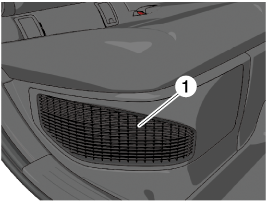
There is an air intake port under the rear seat for cooling the high voltage battery.
-
Air intake port
-
Do not block the air intake port with a seat cover, luggage, or carpet. Otherwise, the temperature of the high voltage battery may increase and the high voltage battery may be damaged. Clean the air intake port regularly to prevent clogging.
-
Do not allow water or foreign matter to get in the air intake port. Otherwise, the high voltage battery could be damaged.
How to clean
Do not clean with water or liquids.
If the high voltage battery gets wet, it may cause a malfunction or vehicle fire.
Do not touch the service plug.
There is a service plug near the air intake port. Do not touch the service plug. If you handle the service plug mistakenly, it could lead to an electrical shock causing serious injury or death.
Always switch the vehicle power OFF before cleaning. In addition, do not put a hand or foot into the air intake port.
Becoming caught in the cooling fan or receiving an electrical shock from touching high-voltage areas may result in serious injury or death.
-
Perform cleaning immediately when a message is displayed on the multi-information display. If you continue driving while the message is displayed, the high voltage battery may be damaged.
-
Do not use an air blower for cleaning. Otherwise, dust could be forced in which could decrease the high voltage battery output or damage it.
-
Heed the following instructions to prevent vehicle damage.
-
Do not allow water or foreign matter to get in the air intake port.
-
Always put back the filter and air intake port cover after cleaning.
-
Do not install a filter from another vehicle or anything other than a filter to the air intake port.
-
Do not drive the vehicle with the filter removed.
-
-
Heed the following instructions to prevent filter damage.
-
Do not use an air blower.
-
Do not press a hard object such as a vacuum cleaner against the filter.
-
Do not use hard brushes such as metal brushes.
-
Do not crush the folds in the filter.
-
-
Switch the vehicle power OFF.
-
Use a flathead screwdriver with a clean cloth wrapped around the end to remove the clip.

-
Clip
-
-
Pull the air intake port cover and remove the clips.

-
Clip
-
-
Pull the air intake port cover and remove the air intake port cover while pulling out the hook.

-
Hook
-
-
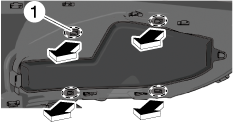
Remove the filter from the 4 tabs locations on the air intake port cover.
-
Tab
-
-
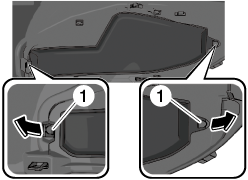
Remove the tabs on both ends, and remove the filter from the air intake port cover.
-
Tab
-
-
Clean the filter.
-
Install in the reverse order of removal.
After cleaning, you may need to drive the vehicle for about 20 minutes until the message displayed on the multi-information display disappears. If the message does not disappear, have the vehicle inspected by an Authorized Mazda Dealer.