Lane-keep Assist System (LAS)
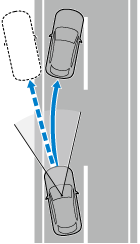
The LAS provides steering assistance to help the driver stay within the vehicle lane if the vehicle might be deviating.
The forward sensing camera (FSC) detects the white lines (yellow lines) of the vehicle lane in which the vehicle is traveling and if the system determines that the vehicle may deviate from its lane, it operates the electric power steering to assist the driver’s steering operation. The system also alerts the driver by displaying an alert on the multi-information display and the active driving display.
Use the system when you drive the vehicle on roads with white (yellow) lines such as expressways and highways.
Do not rely completely on the LAS:
-
The LAS is not an automated driving system. In addition, the system is not designed to compensate for a driver’s lack of caution, and over-reliance on the system could lead to an accident.
-
The functions of the LAS have limitations. Always stay on course using the steering wheel and drive with care.
-
Do not use the LAS under the following circumstances, otherwise it may result in an accident.
-
The vehicle is driven on slippery roads such as icy or snow-covered roads, and unpaved roads.
-
Tires of a different specified size are used, such as a temporary spare tire.
-
Tires with insufficient tread are used.
-
The tire pressures are not adjusted to the specified pressure.
-
The vehicle is being used to tow a camper or boat trailer.
-
Tire chains are used.
-
The vehicle is driven on roads with lane lines other than white (yellow) lines, such as an expressway.
-


The system may not operate normally under the following conditions.
-
A condition under which the forward sensing camera (FSC) cannot detect a target object is met.
Refer to Forward Sensing Camera (FSC) (Search).
-
The visibility of white (yellow) lines is poor (due to paint flaking or dirt, or being hidden by vehicles ahead).
-
There are multiple white (yellow) lines or they are interrupted.
-
A misleading line on the road is picked up (such as temporary line for construction, shadow, lingering snow, or grooves filled with water).
-
The width of a lane is excessively narrow.
-
The vehicle is shaken after hitting a road bump.
-
The vehicle is driven on a section with a closed lane or temporary lane due to construction.
-
The vehicle is driven on a forked road or junction.