Lane Departure Warning System (LDWS)
The LDWS notifies the driver that the vehicle might be deviating from its lane.
The LDWS detects white (yellow) lines using the Forward Sensing Camera (FSC). If your vehicle may be deviating from its lane, the lane departure warning notifies the driver.
Use the LDWS when you drive the vehicle on roads with white (yellow) lines.
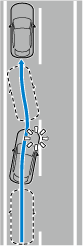
Do not rely completely on the LDWS and always drive carefully:
-
The LDWS is not designed to compensate for a driver’s lack of caution and relying too much on the system could lead to an accident.
-
The functions of the LDWS have limitations. Always stay on course using the steering wheel.


Heed the following cautions so that the LDWS can operate normally.
-
Do not modify the vehicle's suspensions.
-
Always use tires of the specified type and size for the front and rear wheels. Consult an Authorized Mazda Dealer for tire replacement.
When any of the following conditions is met, the LDWS may not operate normally.
-
A condition under which the Forward Sensing Camera (FSC) cannot detect a target object is met.
Refer to Forward Sensing Camera (FSC) (Search).
-
The visibility of white (yellow) lines is poor (due to paint flaking or dirt, or being hidden by vehicles ahead).
-
There are multiple white (yellow) lines or they are interrupted.
-
A misleading line on the road is picked up (such as temporary line for construction, shadow, lingering snow, or grooves filled with water).
-
The shade of a guardrail parallel to a white (yellow) line is on the road.
-
The width of a lane is excessively narrow.
-
The vehicle is shaken after hitting a road bump.
-
The vehicle is driven on a section with a closed lane or temporary lane due to construction.
-
The vehicle is driven on a forked road or junction.
-
The vehicle is driven through an intersection or a roundabout.